• Est. 2011 • Pre-Primary to Vocational • 58 Children Currently Enrolled • Kanigiri, Prakasam District
SKR Residential School for Intellectual Disabilities & Hearing Impairment
What This Programme Does
The SKR Residential School for Intellectual Disabilities and Hearing Impairment (ID & HI) in Kanigiri is a multi-disciplinary residential special school and rehabilitation centre serving children with intellectual disabilities (ID), hearing impairment (HI), and dual disabilities across Prakasam District. Established in 2011 and funded under the Deendayal Disabled Rehabilitation Scheme (DDRS) by the Ministry of Social Justice and Empowerment, Government of India, the Kanigiri school is one of the very few institutions in rural Andhra Pradesh offering simultaneous, integrated support for children with these often co-occurring disabilities.
The Kanigiri school operates on a fundamentally different educational model from mainstream special schools. Because intellectual disability and hearing impairment each require highly specialised, individualised approaches, the school deploys a full multi-disciplinary team — special educators, speech therapists, physiotherapists, psychologists, social workers, and residential care staff — working together for each child under a single Individualised Education Plan.
Children enrolled
%
Gained daily independence
%
Academic improvement
Therapy disciplines deployed
Children We Serve
- Children with mild, moderate, severe, or profound intellectual disability
- Children with Down Syndrome, Cerebral Palsy, Autism Spectrum Disorder
- Non-verbal children with no prior communication system
- Children from rural BPL families — all services at zero cost.
- Children with hearing impairment — partial or total deafness, Children with dual disability — both ID and HI simultaneously
Our Multi-Disciplinary Approach
- Special education: IEP-based learning at each child’s pace and level
- Speech therapy: verbal, non-verbal, and AAC-based communication
- Physiotherapy: motor development, mobility, postural support
- Psycho-social support: behaviour, emotional well-being, family counselling
- Outreach: home-based therapy for children who cannot attend school
- Case monitoring: monthly MDT reviews for every enrolled child
Core Services Delivered
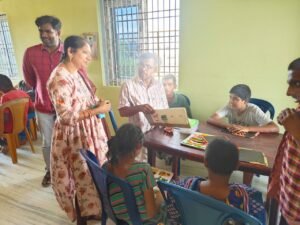
| Special Education — Pre-Primary to Pre-Vocational | |
|---|---|
|
 |
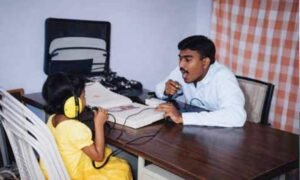
| Multi-Disciplinary Therapy Services | |
|---|---|
|
 |
| Outreach — Home-Based Intervention Programme |
|---|
|